

A palpable under-representation of public health expertise.
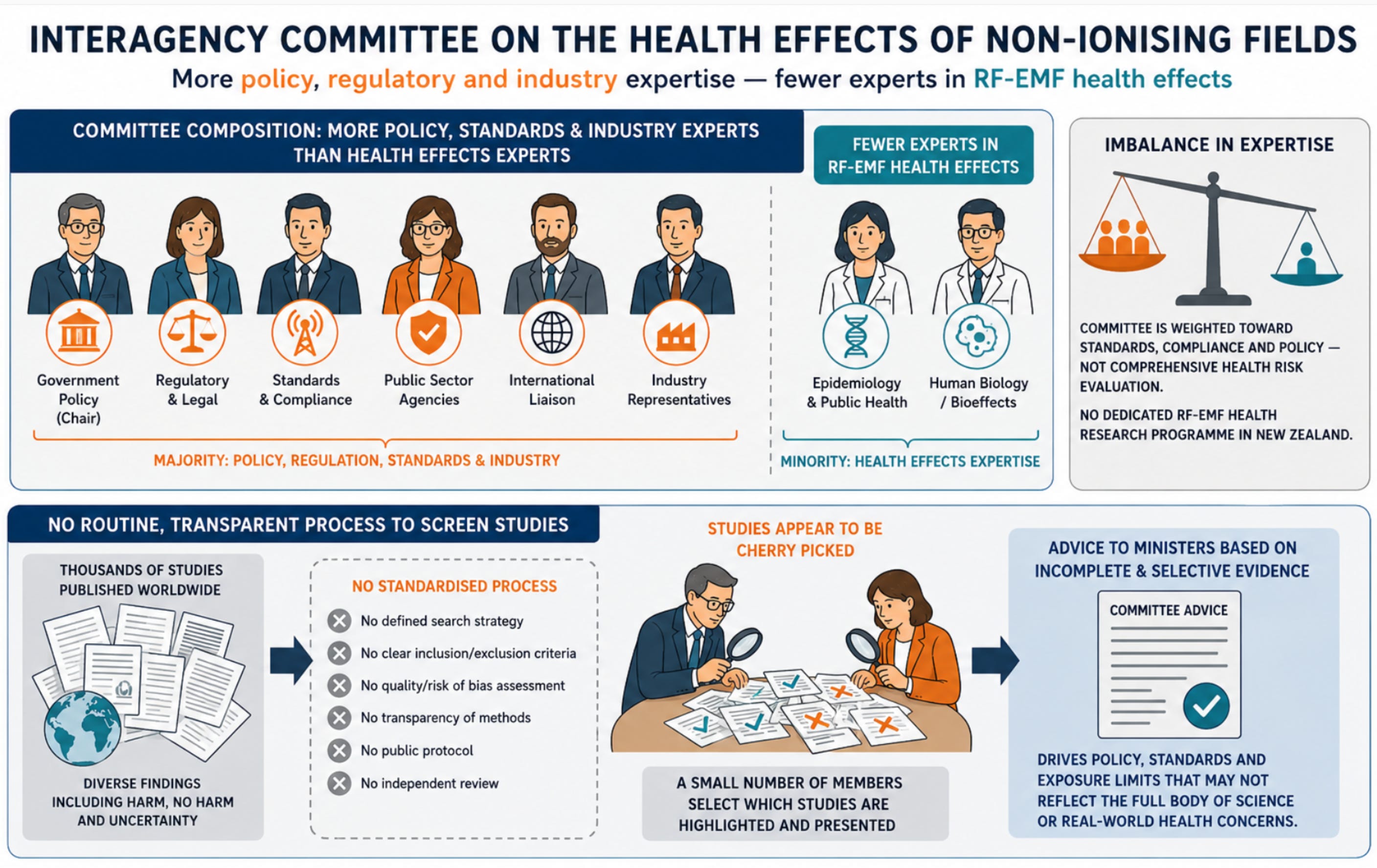
Part 2. A committee weighted toward policy, monitoring standards and compliance, not comprehensive health risk evaluation.

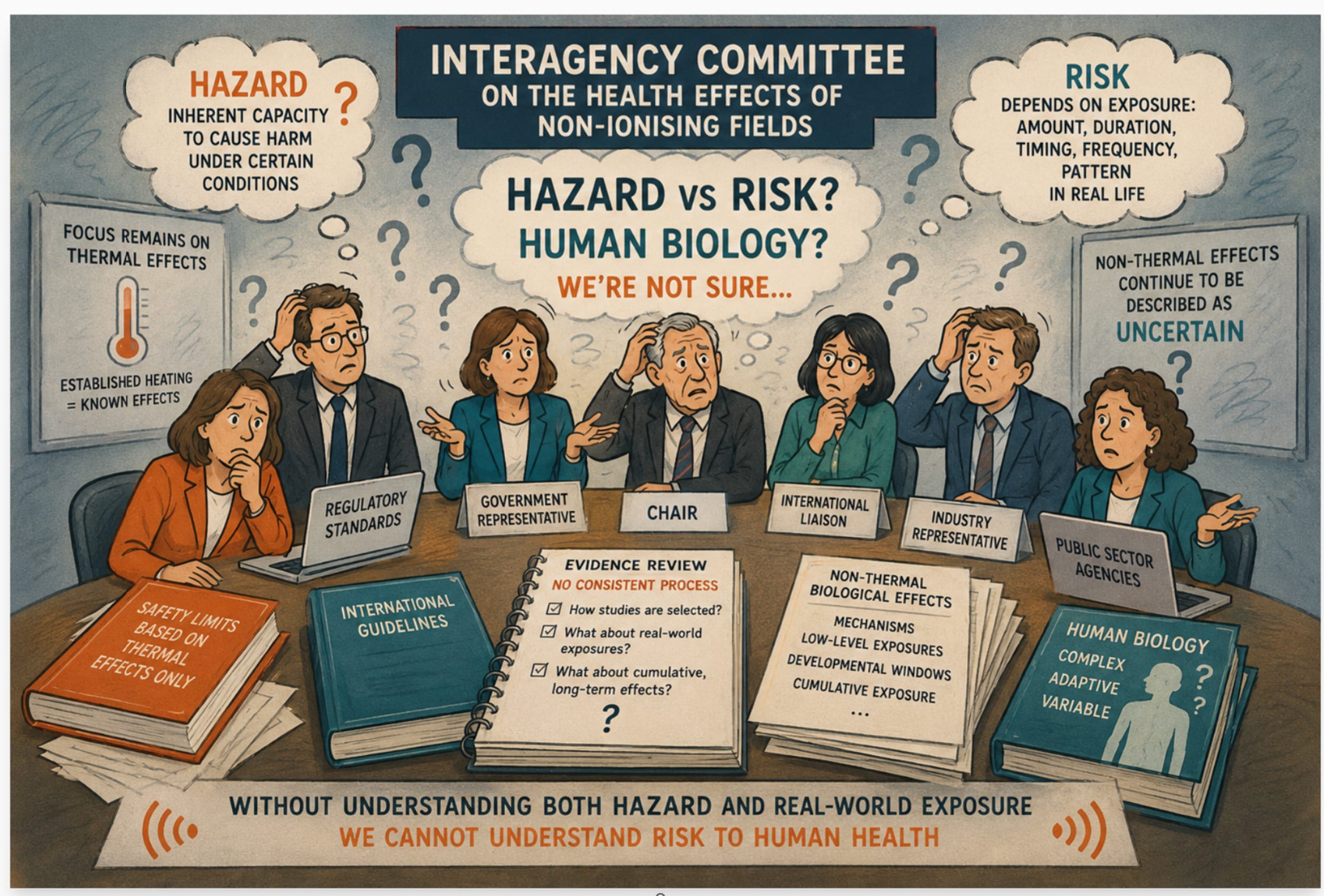
Public sector employees and members of advisory committees occupy positions of public trust. In matters involving radiofrequency electromagnetic fields (RF-EMF), it is therefore important to understand whether members of New Zealand advisory bodies possess the breadth and depth of expertise necessary to evaluate potential risks and emerging evidence. Transparency is a fundamental principle of good governance. By convention, scientific authorship, institutional affiliations, and professional backgrounds are declared so that the nature and scope of technical expertise can be properly understood and assessed.
Understanding which actors hold senior technical authority within a committee is particularly important, because disciplinary background strongly influences how evidence is interpreted, weighted, and translated into policy advice. Expertise grounded primarily in physics, engineering, or exposure assessment may approach uncertainty, biological plausibility, and evidentiary thresholds differently from expertise grounded in toxicology, epidemiology, developmental biology, or public health precaution.
Examining the composition of advisory committees is therefore not a personal exercise, but an enquiry into governance capacity. While it may feel uncomfortable to identify individuals and their professional backgrounds, doing so is central to assessing whether an institution has the scientific breadth, intellectual rigor, and disciplinary diversity required to recognise, interpret, and respond appropriately to new or contested knowledge.
The discussion below has been prepared to the best of our ability based on publicly available information and sources accessible at the time of writing. If any factual errors, omissions, or inaccuracies are identified, please contact PSGRNZ so that corrections or clarifications can be considered.
As we mentioned in the previous Substack, New Zealand’s standards: NZS 2772.1 are regulatory limits built around preventing established thermal effects. New Zealand operates a policy model based on reviewing international evidence through the Interagency Committee on the Health Effects of Non-ionising Fields.
This Substack observes that this Committee lacks sufficient New Zealand-based experts who are fluent in environmental and human RF-EMF risk, even as it is tasked with providing the Director General of Health with high quality, independent scientific and technical advice on any potential health effects from exposures to extremely low or radiofrequency fields.
The Committee is powerful, as its findings have a direct impact on what and where telecommunications facilities can be placed. The environmental standards for telecommunications are currently being relaxed. The new regulations will adhere to legacy limits that the Committee states are safe. There’s been a significant expansion in cell phone towers (including at the start of the first Covid-19 lockdown – page 90) and Internet of Things use across public and private sector institutions including schools and hospitals.
There are no expert local scientists, grounded in human biology who have spent years examining the non-ionising effects of RF-EMF radiation and human health who are advising this Committee. New Zealand does not fund a sustained, dedicated research programme into the biological or health effects of non-ionising RF-EMF radiation.
WHAT SCIENCE IS BEING DONE?
The Interagency Committee on the Health Effects of Non-ionising Fields provides Reports to Ministers which acts as evidence summaries. New Zealand has taken a monitoring and adoption model, with only fragmented or indirect research capacity.
This secondary research has not reflected the rigour of toxicological science. The Reports to Ministers have not been methodologically robust, nor have they addressed the most complex issues that involve long-term health risk at the levels used by people. Reviews that could be identified include:
Ministry of Health. 2022. Interagency Committee on the Health Effects of Non-ionising Fields: Report to Ministers 2022. Wellington: Ministry of Health.
Ministry of Health. 2018. Interagency Committee on the Health Effects of Non-ionising Fields: Report to Ministers 2018. Wellington: Ministry of Health.
Ministry of Health. 2019. 5G Radiofrequency Fields and Health. Wellington: Ministry of Health. (Addendum to the Report to Ministers 2018).
There is no budget within Vote Health that would ensure capacity for New Zealand-based scientists to conduct formal, in-depth risk assessment, or evaluate the quality and findings of foreign research and offshore conclusions and report back to this Committee.
Conventionally, risk is understood as a function of both hazard and exposure. Hazard refers to the inherent capacity of an agent or technology to cause harm under certain conditions, while exposure concerns the extent, duration, timing, frequency, and pattern of contact with that agent in the real world. A substance or technology may present little practical risk if exposure is minimal, but the assessment changes where exposure becomes widespread, prolonged, cumulative, or occurs during vulnerable developmental periods.
In the RF-EMF context, current safety frameworks primarily assess hazard through short-term thermal effects, asking whether radiofrequency exposures generate sufficient tissue heating to cause established adverse effects.
However, these frameworks do not generally require comprehensive assessment of chronic, cumulative, real-world exposure patterns across the life course, including simultaneous exposure from multiple RF sources, prolonged low-level background exposures, near-body device use, or continuous environmental exposures experienced by the general population. In short, this work is not being undertaken.
Therefore, the Committee is the sole institution producing the ‘expert evidence’ that the machinery of government, the media, the judiciary and the public then relies on.
THE INTERAGENCY COMMITTEE ON THE HEALTH EFFECTS OF NON-IONISING FIELDS
The Interagency Committee on the Health Effects of Non-ionising Fields (the Committee) was established in 1989 by the then Ministry of Economic Development to monitor and review research on the health effects of extremely low frequency (ELF) electric and magnetic fields. The scope was extended to include radiofrequency (RF) fields in 2001, at which time the Committee became a Ministry of Health technical advisory committee (MoH 2022).
The Committee’s terms of reference require that it provide the Director General of
Health with high quality, independent scientific and technical advice on any potential health effects from exposures to extremely low or radiofrequency fields including:
the quality and completeness of information on which findings and recommendations have been made
assessment and review of the impact of research and information published locally and overseas, on policies, guidelines and advice promulgated by the Ministry of Health, Ministry for the Environment or Ministry of Economic Development
other technical, scientific and epidemiological matters in relation to the extremely low or radio frequency fields as may be required.
The Committee reports to the Director General of Health, with copies of meeting notes provided to the Chief Executives of the Ministry for the Environment and the Ministry for Economic Development. Should there be reasonable suspicion of health hazards, or other issues of significance, these will be brought to the attention of joint Ministers. Annual and/or occasional reports will also be provided to joint Ministers.
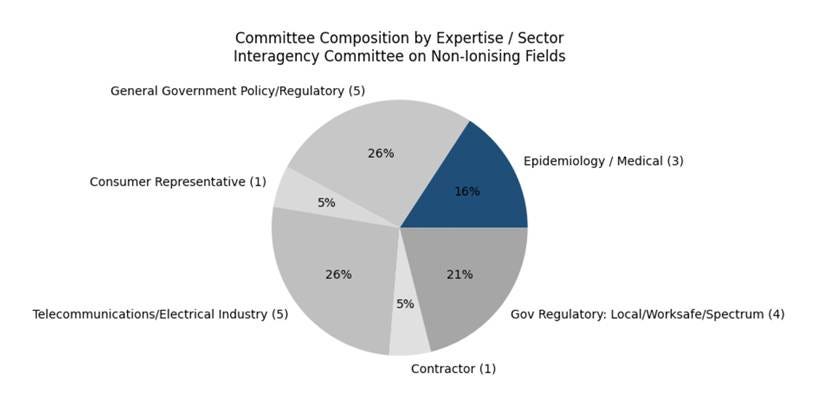
The Committee draws its membership from government ministries, public health units, local government, consumers and the electrical and telecommunications industry. Two invited health researchers were included in 2022, only one of which had worked recently in the field of RF-EMF and human health risk.
The committee is not constituted as a full-spectrum health risk assessment body. The terms of reference imply that something approximate to this is being done.
DO THE MEMBERS OF THE EXPERT COMMITTEE HAVE RF-EMF EXPERTISE?
The majority of (currently declared) ‘experts’ are public and private sector people involved in policy, compliance, technical exposure assessment and engineering (e.g. field measurement, standards compliance), including in contracting their services to public agencies and private industry. A large proportion of Committee members are primarily qualified in environmental standards, physics and engineering.
These are appropriate experts for radiation measurement and standards compliance, but not sufficient for comprehensive long-term biological risk evaluation. Regulatory compliance frameworks are not equivalent to comprehensive health risk assessment. Demonstrating that exposures fall below existing thermal-based standards does not, in itself, establish absence of risk under chronic, cumulative, low-level real-world exposure conditions. Compliance assessment answers whether exposures exceed established thresholds; it does not necessarily answer whether current thresholds fully capture all relevant biological risks.
Disclosures to the current date, suggest that the Committee contains no permanent New Zealand members who, as scientists or researchers, who have spent substantial portions of their careers actively researching RF bioeffects, mechanistic non-ionising radiation biology, neurodevelopment, oxidative stress, reproductive biology, or systems toxicology. These are issues central to the discussion on the health and safety of RF-EMF.
As such, the capacity of the Committee to discern what is ‘high quality’ science across the fields of human (and environmental) health, may be limited.
Ministry of Health disclosures are sporadic, the membership of the group is rarely publicly disclosed, with the public resorting to making Official Information Act requests (see e.g. H2022017727). The last disclosure, in 2022 (now out of date), revealed these people as serving members:
Richard Jaine: Chair, Representative of Manatū Hauora
Sally Gilbert: Secretary, Representative of the National Public Health Service
Martin Gledhill: Representative of the National Public Health Service
Pip Parkin; Representative of the National Public Health Service
Kimbal McHugo: Representative of the Ministry of Education (Infrastructure and asset management) (Optimised Energy Ltd)
Lucy Knowles: Representative of the Ministry for the Environment
Paul Molloy: Representative of Workplace Health & Safety (Applied chemistry and environmental quality management.)
Jeremy Logan: Representative of the Radio Spectrum Management Group
Veerendra Bhim: Representative of Energy Safety (Worksafe)
Isobel Stout: Representative of local government (environmental regulation compliance)
John Dockerty: Academic representative
Andrea t’Mannetje: Academic Representative
Nick Gelling: Representative of consumer interests
Ben Blakemore: Representative of the telecommunications industry
Adam Tommy: Representative of the telecommunications industry
Hayley Head: Representative of the electrical industry (transmission and supply)
Peter Berry: Representative of the electrical industry (transmission and supply)
Matthew Walker: Representative of the electrical industry (transmission and supply). Environmental Specialist, Transpower.
Of the public sector officials:
Richard Jaine is a senior public health physician, working as a deputy director of public health. His primary research interest concerns lung cancer and tobacco control.
The academic representatives include an expert in childhood leukemia, epidemiologist Professor John Dockerty, who undertook some research into RF-EMF some two decades ago (more recent research could not be identified). Associate Professor Andrea t-Mannetje’s research included childhood and adolescent exposure to EMF fields, and hence was perhaps the academic member with the most direct expertise.
John Dockerty appears to select papers (see e.g. H2022017727), while other Official Information Act requests outcomes have not disclosed who selected more recent papers (e.g. H2025077086). The processing of selecting and discarding papers is not declared.
An internet audit to identify published papers and information since 2015 by members of the 2022 committee could not identify any relevant expertise in publicly disclosed members Sally Gilbert (disease surveillance and biosecurity), Pip Parkin, Kimbal McHugo, Lucy Knowles, Paul Molloy, Jeremy Logan, Veerendra Bhim, Nick Gelling, Hayley Head.
From the 2022 Committee membership, one consumer representative could be identified, with the balance acting on behalf of the private sector and/or as a contractor providing technical measurement and advisory services.
There is no published record of earlier Committee membership despite the Committee having been established for nearly 30 years. The 2022 declaration is out of date, but the current serving committee membership is not declared.
WHO HOLDS THE MOST INSTITUTIONAL KNOWLEDGE?
As there is a lack of transparency concerning who selects the scientific studies and reports favoured by the Committee, it is likely that the public sector institutional knowledge is predominantly held by Committee members John Dockerty and Martin Gledhill. Gledhill is formerly head of the non-ionising radiation section at the National Radiation Laboratory of the New Zealand Ministry of Health; as well as Committee observers - Ken Karipidis and Sarah Loughran. Karipidis and Loughran hold directorships within the Australian Radiation Protection and Nuclear Safety Agency (ARPANSA).
In 2022, Martin Gledhill occupied the position of Acting Secretary.
Both Gledhill and Karipidis have educational and professional backgrounds grounded primarily in physics and radiation protection frameworks rather than toxicology, molecular biology and developmental biology. Loughran’s PhD was in cognitive neuroscience and psychophysiology.
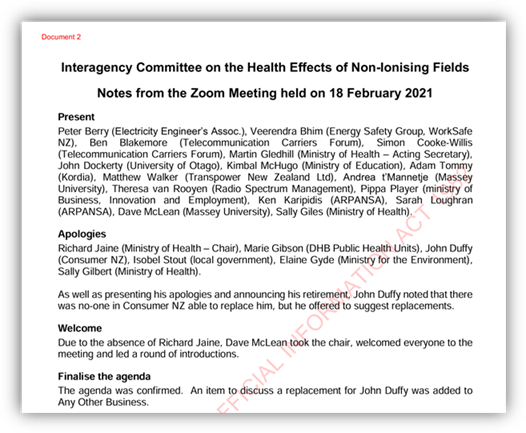
MARTIN GLEDHILL.
The 2022 Report stated that Martin Gledhill was a ‘Representative of the National Public Health Service‘. However, no evidence could be located that Gledhill was a full time staff member within the Ministry of Health at this time. While not disclosed, PSGRNZ speculate that Gledhill may have been contracted to work on the Report to Ministers.
Martin Gledhill participates in international EMF governance and advisory meetings closely connected to ICNIRP, such as the WHO EMF Project. Gledhill is the owner/director of EMF Services and Monitoring and Advisory Services NZ Ltd (MAASNZ), an organisation that contracts EMF measurement and advisory services to the private and public sector. Gledhill was author of the report Exposures to radiofrequency fields near 5G cellsites. Report to the Ministry of Health. Report 2020/40.
Gledhill’s background may be best understood from a February 2023 statement of evidence:
‘I have an MA degree in Natural Sciences (Physics) and an MSc in Medical Physics. I am a member of the Australasian Radiation Protection Society and of the Bioelectromagnetics Society (recently renamed BioEM). I serve on the Standards New Zealand/Standards Australia committee on “Human exposure to electromagnetic fields” which develops exposure assessment standards and also on the Institute of Electrical and Electronic Engineers (IEEE) International Committee on Electromagnetic Safety (ICES), which develops EMF assessment and safety standards internationally. I am a Director of Monitoring and Advisory Services NZ Ltd (MAASNZ), which through its EMF Services division provides measurement and advisory services related to possible health effects of electromagnetic fields (EMFs). These services are provided to central and local government (including the Ministries of Health and the Environment), the public and industry. Before forming MAASNZ in 2011 I was head of the non-ionising radiation section at the National Radiation Laboratory of the New Zealand Ministry of Health, where my role was similar to what it is now. Both with the Ministry of Health and with my own company my work has included the assessment of electromagnetic fields around AM radio transmitters of the type at the Radio New Zealand (RNZ) Titahi Bay site.’
ARPANSA OBSERVERS: KEN KARIPIDIS & SARAH LOUGHRAN
Ken Karipidis is Assistant Director at Australian Radiation Protection and Nuclear Safety Agency (ARPANSA). Karipidis serves as the Vice Chair of International Commission on Non-Ionizing Radiation Protection (ICNIRP), and has long-standing involvement with New Zealand’s interagency committee structures. From 2003-2024, Karipidis has held the position of ‘observer’ on New Zealand’s Interagency Committee on the Health Effects of Non-Ionising Fields.
Sarah Loughran specialises in bioelectromagnetics, sleep, and EEG signal analysis research and is the Director of Radiation Research and Advice, and the Principal Researcher and Director of the Electromagnetic Energy Program at the Australian Radiation Protection and Nuclear Safety Agency (ARPANSA). Loughran is a member of the current World Health Organisation (WHO) RF Environmental Health Criterion evaluation committee and is an elected member of the International Commission on Non-Ionizing Radiation Protection’s (ICNIRP) Scientific Expert Group.
Loughran is also a Chief Investigator for the Australian Centre for Electromagnetic Bioeffects Research (ACEBR), an Australian NHMRC Centre of Research Excellence (CRE).
ARPANSA has a prominent role in developing policies and preparing draft regulations for Commonwealth entities that use or produce radiation with the objective of protecting people and the environment from the harmful effects of radiation. The research role is focussed on radiation protection, nuclear safety and medical exposures to radiation. ARPANSA has oversight over the Radiation Health and Safety Advisory Council which is tasked with the identification of emerging issues relating to radiation protection and nuclear safety, and the Radiation Health Committee which is ‘from time to time’ engaged to review national policies, codes and standards in relation to radiation protection to ensure that they continue to substantially reflect world best practice.
The legislation which provides the powers for the Australian bodies, as with New Zealand, does not establish this group as a scientific research centre but rather requires findings to align with international best practice.
DOMINANT INSTITUTIONS CONVERGE ON THERMAL-BASED RF-SAFETY FRAMEWORKS
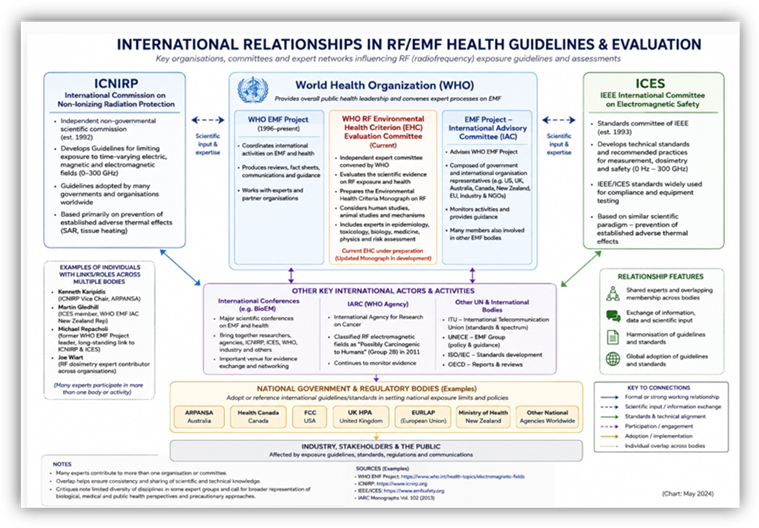
The institutional backgrounds of Gledhill, Karipidis and Loughran situate them as long-standing ‘experts’. Their relationships with ICNIRP matter sociologically as well as scientifically. They reflect professional paradigms, institutional cultures, and peer networks historically shaped around radiation physics, exposure assessment, dosimetry, and compliance with established exposure standards.
Although Karipidis and Loughran are non-members who ‘only’ act as observers, they hold substantial institutional knowledge, and likely function as enduring sources of authority and continuity for committee members who rotate in and out over time. (Jasonoff 2004, Haas 1992).
The International Commission on Non-Ionizing Radiation Protection (ICNIRP) primarily functions as a public-health-oriented scientific commission that develops broad exposure guidelines for non-ionising radiation. Its recommendations are designed to support health protection policy and are frequently adopted, referenced, or adapted by governments and regulatory agencies around the world. ICNIRP frames its work within a radiation protection and public health context, with a strong emphasis on establishing exposure limits intended to prevent scientifically established adverse effects in humans.
In contrast, the IEEE International Committee on Electromagnetic Safety emerged from the engineering and technical standards environment of the Institute of Electrical and Electronics Engineers. The International Committee on Electromagnetic Safety (ICES) operates under the rules and oversight of the IEEE Standards Association Standards Board and is responsible for development of standards for the safe use of electromagnetic energy in the range of 0 Hz to 300 GHz relative to:
the potential hazards of exposure of humans, volatile materials, and explosive devices to such energy,
standards for products that emit electromagnetic energy by design or as a by-product of their operation, and
standards for environmental limits.
ICES is more technically and engineering focused, developing detailed standards, dosimetry methods, compliance protocols, measurement techniques, and equipment testing frameworks used in telecommunications, electrical engineering, and regulatory compliance. While ICES also addresses health protection, its orientation is more closely linked to technical standardisation and practical implementation within engineering systems.
Historically, the World Health Organization EMF Project drew heavily on experts associated with both ICNIRP and ICES. As a result, there has been considerable overlap in expert participation, scientific framing, and methodological approaches across these organisations.
Despite their differing institutional cultures, ICNIRP and ICES have historically arrived at broadly similar RF exposure limits because both organisations rely largely on comparable thermal-threshold assumptions.
In practice, this means that their guidelines are primarily based on preventing established adverse heating effects in tissues, using dosimetric measures such as specific absorption rate (SAR), rather than on precautionary approaches centred on unresolved non-thermal or long-term biological effects.
Within that framework, the dominant assumption has generally been that non-thermal RF-EMF exposures below existing guideline thresholds are unlikely to present significant health risks.
As a result, alternative perspectives grounded in toxicology, mechanistic biology, developmental vulnerability, or cumulative environmental health risk have had comparatively limited institutional representation within the committee structure.
This is then reflected in the domestic institutions whose origin was in radiation safety and whose findings reflects the findings of these larger groups.
NEW ZEALAND COMMITTEE: AD HOC & LACKING IN SCIENTIFIC RIGOUR
Instead of contracting scientists to undertake human health risk assessments which can assess risk and hazard according to New Zealand conditions, the Committee appears to rely heavily on reviewing external research, standards bodies, and ARPANSA/ICNIRP-type assessments.
The inability of the Committee to provide high quality, independent scientific and technical advice on any potential health effects from exposures is reflected in the ‘Report to Ministers’ (2015, 2018, 2022).
The Reports are unauthored, no methodology is declared that would suggest an independent approach to reviewing studies, there is no rigorous approach for reviewing studies and meta-analyses in order to discern what is ‘high quality’ and what is not across the different disciplinary fields (e.g. evidence comes from biomarker, mechanistic, case, cohort and epidemiological data), as would be expected from formal toxicological analyses. Instead comments lean heavily on ICNIRP findings, and tend to claim ‘quality’ or not – without robust explanation.
We suspect that one or two people have a major role in selecting the science and declaring the quality of the studies and drafting the Report to Ministers. Our guess is that if the paper was authored by academic scientists, they would have appeared on the paper as the primary authors.
A recent OIA request illustrated the vague approach to gathering and assessing scientific evidence. Request no. H2025077086 asked for:
All records from 2020–2025 relating to health risk assessments, expert committee findings, or ministerial briefings on smart meter exposure, electromagnetic sensitivity (EHS), and non-ionising radiation from consumer devices. Include any guidance issued to health practitioners, Public Health Units, or electricity retailers.”
The response listed stated:
Information pertaining to the majority of your request can be found in the Interagency Committee on the Health Effects of Non ionising Fields Report to Ministers 2022 which is publicly available through the following link: www.health.govt.nz/publications/interagency committee-on-the-health-effects-of-non-ionising-fields-report-to-ministers-2022. The Ministry notes that this information has previously been provided to you (OIA H2025071277 refers). The report contains sections on smart meters, electrohypersensitivity, personal devices, Wi-Fi and the Internet of Things.
The Interagency Committee on the Health Effects of Non-ionising Fields meet every six months to discuss recent reviews and research papers. The minuted conclusions at the end of these meetings, at which these reviews/papers have been discussed, are that no changes to current policies and recommendations are needed. The relevant abstracts presented at the Committee meetings from 2020-2025 are compiled and attached as Document 1 in accordance with section 16(1)(e) of the Act. For expert reviews, the title, name of the expert group and a link to the report is provided. For research papers, the publication details and the abstract and the abstract presented to the Committee are supplied.
No health risk assessments have been undertaken by the Ministry or by Health New Zealand – Te Whatu Ora. Aside from the Interagency Report itself, no ministerial briefings or guidance have been provided to health practitioners, Public Health Units/Services, or electricity retailers during the period requested. Therefore, these parts of your request are refused under section 18(g)(i) of the Act as the information requested is not held by the Ministry and there are no grounds for believing it is held by another agency subject to the Act.
The abstracts supplied in the OIA request response (up to 2025) comprise a mixture of reports and scientific studies. There is no indication of the criteria used to select these studies, nor any transparency as to who determined their inclusion.
Worryingly, as there is no group of relevant experts, the Committee membership lacks weighted expertise in epidemiology, human biology and toxicology.
Hence the Committee is unlikely to challenge the ‘scientific experts’ who select the science, claim the quality of the selected studies, and who then draft the Report.
The material provided does not include studies concluding that prevailing RF-EMF exposure levels are unsafe; rather, it predominantly comprises provocation and nocebo-focused studies that do not identify causal health effects. The evidence base presented is methodologically narrow. It does not meaningfully engage with research on chronic exposure, underlying biological mechanisms, developmental vulnerability, or cumulative risk, thereby limiting its relevance to long-term health assessment.
This is difficult to reconcile with the breadth of the scientific literature, which includes a substantial body of mechanistic, case, and cohort research that does not appear to have been presented to the Committee for consideration.
In Conclusion
In the absence of a transparent and systematic process for evidence selection, it is unclear how Committee members, particularly those from the public sector, have the expertise to independently assess the full scope of the science and associated risk. The process appears dependent on a narrow and opaque pipeline of information and the assertions of a minor group of participants.
Within this context, it is also notable that industry representatives have no apparent incentive to expand consideration of non-ionising biological effects beyond the current regulatory framework.
It seems that the public sector members, even if they were interested in more actively understanding the science and the risk, are at the whim of the mysterious people that design and draft the Reports to Ministers, which form the rationale for retaining existing regulations, and that the industry sector are content with non-ionising effects remaining outside the regulatory framework.
As of 2026, no routinely updated public membership register for the Interagency Committee on the Health Effects of Non-Ionising Fields could be identified. The most recent detailed disclosure of named members located by PSGRNZ remains associated with the 2022 Report to Ministers and related Official Information Act responses.
Current Health New Zealand webpages (last updated March 5, 2026) describe membership only in broad categorical terms (government, industry, academic and consumer representatives) without identifying individual members, observers, declarations of interest, or terms of appointment.
ANY GOVT EMPLOYED BOARD WILL NOT BE HINDERED BY KNOWLEDGE AND THAT IS WHAT GOVT WANTS, IT WOULN'T BE GOOD IF THE PUBLIC NEW HOW BAD OUR GENERAL HEALTH WILL BECOME WITH THE ADVENT OF 5G AND LOW FREQUENCY RF.