

EXPOSING THE TREATMENT GAP: When New Zealand’s long-term mental wellbeing strategy ignores the role of nutrition in protecting and sustaining mental health.
SAANZ CONFERENCE '25, VICTORIA UNIVERSITY OF WELLINGTON. PAPER PRESENTATION. J.R.BRUNING

Sociological Association of Aotearoa New Zealand (SAANZ)
A Sociology of Beauty and Joy
Session 2.4: Mental Health and Wellbeing Wednesday December 3, 2025 1:30pm - 3:00pm [3rd speaker]. PST CO118 Chair: Hafsa Tameez
People diagnosed with a mental illness in New Zealand have a choice of psychological therapies, pharmaceuticals, and self-care. Nutrition is not a first-line treatment. The He Ara Oranga Report of the Government Inquiry into Mental Health and Addiction, acknowledged the link between poor nutrition and mental health. However, the Physicians & Scientists for Global Responsibility (PSGR) have found that this recognition was not translated into the ten-year strategy, Kia Manawanui Aotearoa: Long-term pathway to mental wellbeing (2021) (2023). Nutrition remains absent from government policy, promotional material, and treatment pathways (forthcoming paper).
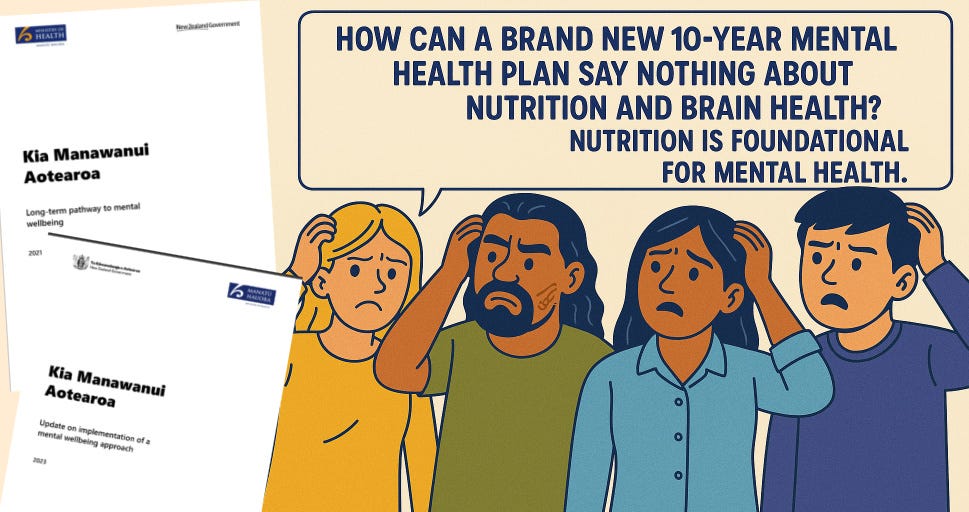
PSGR can also identify that in the past ten years, the New Zealand government has doubled expenditure on pharmaceutical drugs, while research to provide a greater understanding of nutrient needs by age, stage, gender, race, genetic, dietary socio-economic, pregnancy and general health (including presence of inflammation) status has stagnated.
Thousands of mechanistic, clinical, and cohort studies showing that inadequate levels of essential fatty acids, vitamins and minerals are associated with most mental health conditions. The consistency and strength of findings are supported by systematic reviews and meta-analyses, including randomised control trials.
Psychiatric medication is the first line of treatment for people diagnosed with a psychiatric condition. However, 30% of people diagnosed with major depressive disorder or psychosis are expected to be non-responsive to the psychiatric drugs,[1] [2] while 20-40% of people with ADHD are likely to be non-responsive, or ‘treatment resistant’.[3] As psychiatric medications have large side effect profiles, people who cannot tolerate the side effects are left without a choice.
Pregnant women who have anxiety, depression or ADHD face a difficult decision – randomised control trials have never been conducted for their psychiatric medication on pregnant women. It is not ethical. In addition, very few trials have been held for young people, and they haven’t been tested for long-term use. Should pregnant women, or children and young people still in growth phases be prescribed psychiatric drugs as a first line treatment, or can we do better and run a nutrient panel to assess insufficiency, and recommend dietary changes and nutrient supplementation?
Deficiency and insufficiency are very different issues. Government guidance for daily supplementation concerns frank deficiency, not optimum requirements. Health agencies have no knowledge on how to optimise nutrition for mental health – particularly for young people and the developing brain. Insufficient micronutrient levels can impair optimum metabolic and neurological development, mitochondrial functioning and cellular, including neurohormone signalling. Insufficient nutrition reduces the body’s (including the brain’s) capacity to repair inflammation and reverse degeneration.
New Zealand social scientists acknowledge the relationship of food insecurity and diet quality with mental health, but micronutrient status as a key element for brain health and the ethical impact of under-dosing is not addressed. This research gap deserves more scrutiny. Are we underdosing vulnerable populations because the government locks in nutrition to levels only intended to prevent frank deficiency?
Is New Zealand missing a massive opportunity for health reform, because, to quote Professor Julia Rucklidge, one of New Zealand’s most cited scientists, nutrition is the essential foundation for mental health?
Cultures of non-knowledge perpetuate ignorance. Government mental health policy omits nutrition. Hence nutrition can be neither a driver of risk and suffering nor a potential means of recovery and resilience. The treatment gap does not exist. The status quo privileges pharmaceuticals while eliding and ignoring metabolic and neurocognitive requirements, particularly during key developmental periods.
What does choice and informed consent mean - amid prevailing institutional ignorance? If we do not know?
Existing maximum levels are based on decades old science focussed on prevention of deficiency - published by the Australian National Health and Medical Research Council (NHMRC). This presents an ethical failure – what levels are required for optimum mental health are not known by authorities.
Numerous Catch-22’s in medicines regulation adversely impair nutrient access. The legislation does not require that chemical or biological toxicity is identified for a nutrient to be recategorized as therapeutic, and therefore as a medicine. Despite the essential physiological role of micronutrients, if any nutritional compound, whether a vitamin, mineral, and essential macronutrient (including amino acids and essential fatty acids), is clearly stated as intended to treat, cure, or prevent a metabolic and/or psychiatric or developmental syndrome or disease, that product can legally be accorded ‘therapeutic’ status.
If any nutrient is prescribed above the levels recommended as a maximum daily dose specified by the forty year old Dietary Supplements Regulations 1985 Medsafe will categorise that micronutrient formulation as a medical drug. Supplements with nutrients at higher/pharmacological doses than the specified maximum daily doses must meet the requirements of the Medicines Regulations 1984.
Thousands of scientific papers from the cellular and mechanistic, to case and cohort studies – show the metabolic impact of micronutrients on physiological, including brain health.
A medical drug designation either means a doctors prescription is required, or that the marketer must pay fees to ensure it can be available off the shelf. Nutrients rarely have protections like patents, and lack the financial margins of conventional drugs. However, the minute labelling or marketing notes a metabolic effect – as a therapeutic effect – Medsafe rules it as a medical drug under the Medicines Act 1981.
The therapeutic claim triggers regulation and the nutrient is forced into a pharmaceutical framework. This is irrespective of the evidence that the formulation may be addressing a known biological deficiency, and irrespective of the evidence that at the level prescribed there is not a risk of harm to that person.
The paradox is evident – biological necessity is of no concern to health authorities, even though under the Health Act 1956, these agencies are required to protect health.

A recent case study showed Medsafe in action. Multinutrients expressly designed to support mental health triggered the ‘therapeutic claim’ regulation. Canadian company Hardy’s produces the Daily Essential Nutrient, (DEN and DENV) multinutrients. Medsafe flagged that Hardy’s were making a therapeutic claim, and recategorized DEN/DENV multinutrients as a medical drug. No adverse event report had triggered this move. The product had been on sale in New Zealand for a decade, with a history of safe use in children, adolescents and adults. The product has been extensively researched and much of the research had been undertaken by a New Zealand research cohort.


Prior to flagging the multinutrients as a therapeutic drug, Medsafe demanded the withdrawal of the original Hardy’s DEN multinutrient formulation due to environmentally relevant levels of lithium orotate in a food ingredient. The levels were orders of magnitude below the levels prescribed in industrially formulated lithium which is used as a treatment for bipolar disorder and schizophrenia. No risk occurs from lithium at the naturally present level. This was not a concern to Medsafe. The technical guidelines had been exceeded.
Medsafe then highlighted the higher than guideline levels of vitamin B12 and zinc in the Hardy’s multinutrient formulation. New Zealand’s 40 year old Dietary Supplements Regulations 1985 are based on Nutrient Reference Values for Australia and New Zealand. There is no known upper limit where harm occurs for vitamin B12, while the level for zinc was established because that is the level when increased zinc levels naturally reduce copper levels in the body. Risk to humans was not an issue.
A quick recap: Guideline levels based on preventing deficiency, and the maximum levels do not present any risk. Medsafe was presented with information showing the documented safety profile. The specific role of these high-dose nutrients in treating depression, anxiety and ADHD and the ethics and benefits, particularly for children and young people, of a much-reduced side effect profile than psychiatric medication was highlighted.
Even though micronutrients act therapeutically through their natural role in cellular and metabolic function- they are automatically relegated to the status of a drug the minute a therapeutic pathway is identified. Optimum nutrient levels that are required to address nutritional insufficiency, or levels required to reduce inflammation and address chronic illness, are not known nor understood by the global authorities that establish RDIs and they are not known by New Zealand authorities.
Following Medsafe’s actions, Professor Julia Rucklidge, a subject matter expert, applied to Medsafe to reclassify lithium (at environmentally relevant levels up to 3mg) and vitamin D (from 25 micrograms to 75 micrograms) as natural health products under a certain dose.
Rucklidge’s application was rejected. The 74th meeting of the Medicines Classification Committee considered that the higher level of vitamin D was likely for a therapeutic purpose (automatically relegating it as a medicine), and highlighted that the benefits were not clear, and expressed concern that misuse was of concern. The higher level of lithium prompted the Committee to discuss the risk of adverse reactions and interactions with other medicines. The Committee concluded that insufficient information was supplied. The Committee noted that some sections of the submission were not completed, including an integrated risk-benefit assessment.
The Committee may be confounding risk from nutrients with risk from a medical drug. The literature does not show risk at the low levels because these nutrients are bioavailable and easily taken up by the body. When questioned by myself about the inadequate explanation of benefits in the application, Rucklidge explained the Catch-22:
if she drew attention to the benefits these would be categorised as a therapeutic benefit and the nutrients automatically relegated to the status of a drug.
The hegemony of the pharmaceutical industrial complex is expressed through health-system architecture and an institutional medical mindset embedded in official culture. Andrea Saltelli and colleagues describe an “epistemic ladder,” whereby private interests progressively penetrate regulatory systems beyond mere lobbying. The present case study illustrates not only science influencing policy, but the embedding of a medical worldview in legislation that conflates the therapeutic potential of known-safe nutrients with risky medical drugs. Officials are cognitively captured. From a fairness perspective, it is unjust for regulatory frameworks to ignore the essential nature of nutrients, thereby creating barriers to fundamental elements of human health, - yet this remains the norm.
Dal Bó (2006) noted that regulators “may come to view the world the way firms do, not because they have been captured through incentives, but because they have been convinced.” Ministry of Health officials do not recognise under-dosing of micronutrients as a probable health concern; they prioritise compliance with guidelines. Cognitive capture extends beyond ignorance to a default assumption that higher nutrient levels are intrinsically risky. Accustomed to pharmaceutical applicants providing drug dossiers, officials show little inclination to investigate independently, even when evidence suggests higher nutrient intake would be beneficial. They do not seem to differentiate between a commercial applicant presenting proprietary drug data and an independent public-health expert without financial interest presenting scientific findings. This “merchants of doubt” dynamic leaves officials paralysed when confronted with moral concerns about under-nutrition, particularly in youth and pregnant women. The cultural capture within the Ministry of Health, Medsafe and committee structures is evident.
Can doctors practice informed consent if nutrition is relegated to a minor determinant? Is nutrition truly a ‘choice’ if it remains unrecognised by the legitimising actions of the state?
Using the sociological imagination, we can envisage a world where nutrients with a long history of safe use are not classified as drugs merely because they have therapeutic value. We can envisage children, young people and pregnant mothers being offered dietary adjustments and high-dose nutrients as first-line interventions, supported by psychological care. We can envisage those with treatment-resistant conditions, or who cannot tolerate the side-effects of psychiatric drugs, having the option of high-dose multinutrients.
We can envisage recognising that stress and trauma, including bereavement, can deplete micronutrient reserves, prompting careful nutritional monitoring and real choice in therapeutic support.
Using the sociological imagination, we can envisage a government with the ethical backbone to keep safe multinutrients readily accessible rather than medicalised into prescription-only status. And we can envisage Pharmac placing long-established, safe multinutrient formulations on the free schedule, so that low-income families and children in critical growth phases have genuine access.
Forthcoming paper.
REFERENCES
Bradley HA, Moltchanova E, Mulder RT, Dixon L, Henderson J, Rucklidge JJ. (2024) Efficacy and safety of a mineral and vitamin treatment on symptoms of antenatal depression: 12-week fully blinded randomised placebo-controlled trial (NUTRIMUM). BJPsych Open. 2024 Jun 3;10(4):e119.
Chen MH, Huang KL, Hsu JW, Tsai SJ (2019. Treatment-resistant Attention-deficit Hyperactivity Disorder: Clinical Significance, Concept, and Management. [3]
Dal Bo, E. (2006). Regulatory capture: A review. Oxford Review of Economic Policy, 22, 203–225.
He Ara Oranga, Report of the Government Inquiry into Mental Health and Addiction. Published in November 2018 by the Government Inquiry into Mental Health and Addiction 978-0-9941245-2-4 (print)
Legge SE, Dennison CA, Pardiñas AF, et al. (2020). Clinical indicators of treatment-resistant psychosis. The British Journal of Psychiatry. 216(5):259-266. [2]
McIntyre RS, Alsuwaidan M, Baune BT, et al. (2023). Treatment-resistant depression: definition, prevalence, detection, management, and investigational interventions. [1]
Medsafe. Minutes for the 74th meeting of the Medicines Classification Committee held at 133 Molesworth Street, Wellington on 23 July 2025. Published October 30, 2025.
Mills CW. (1959) The Sociological Imagination. Oxford University Press.
Ministry of Health. 2021. Kia Manawanui Aotearoa: Long-term pathway to mental wellbeing. Wellington: Ministry of Health.
Ministry of Health. 2023. Kia Manawanui Aotearoa: Update on implementation of a mental wellbeing approach. Wellington: Ministry of Health
NHMRC (2017) Australian Government Department of Health and Ageing, New Zealand Ministry of Health. Nutrient Reference Values for Australia and New Zealand. Canberra: National Health and Medical Research Council; 2006. Version 1.2. Updated September 2017.
Oreskes, N., & Conway, E. M. (2011). Merchants of doubt: How a handful of scientists obscured the truth on issues from tobacco smoke to global warming. Bloomsbury Publishing.
Rucklidge JJ, Bruton A, Welsh A, Ast H, and Johnstone, J.M. (2025), Annual Research Review: Micronutrients and their role in the treatment of paediatric mental illness. J Child Psychol Psychiatr, 66: 477-497.
Rucklidge JJ, Johnstone JM & Kaplan BJ (2021) Nutrition Provides the Essential Foundation for Optimizing Mental Health, Evidence-Based Practice in Child and Adolescent Mental Health, 6:1, 131-154,
Saltelli A, Dankel DJ, Di Fiore M, Holland N, Pigeon M. (2022) Science, the endless frontier of regulatory capture, Futures 135 (2022) 102860

Thank you for your efforts with this important topic.
Could gender dysphoria be prevented by nutritional therapy?
https://www.westonaprice.org/health-topics/how-to-ensure-optimal-hormonal-development-in-your-child/#gsc.tab=0